

May 2026 | 8 min read
Most revenue leaders have the same tool for two very different problems. Forecasting tells you where you’ll land based on what’s already in the pipeline. It’s mature, well-understood, and deeply embedded in most GTM stacks: Salesforce, Clari, Gong, and HubSpot. When the question is “How are we tracking against the number?” forecasting is the default answer.
But a quieter conversation has been gaining momentum in C-suite circles: what if that’s the wrong question entirely?
Predicting where current pipeline lands is not the same as planning what next year’s revenue should look like, and the tools, inputs, and mindsets required are fundamentally different. This post takes an honest look at both: what each does well, where each falls short, and how to know which problem you’re actually trying to solve.
What Forecasting Solutions Are Built to Do
Forecasting tools exist to answer one core question: what revenue will we close, and when?
They do this by analyzing your existing pipeline: deal size, stage, age, rep history, engagement signals and generating a probability-weighted view of your likely close. The best modern forecasting platforms layer in AI to improve accuracy, flag at-risk deals, and help sales managers have better pipeline conversations.
For sales-led organizations with established pipelines, this is genuinely valuable. Forecasting gives you:
- A reliable view of where the quarter is likely to land
- Visibility into which deals need attention
- A basis for board and investor reporting
- Quota attainment tracking at the rep and team level
The best forecasting tools also offer some benchmarking, typically around closure rates from opportunity stage onward, and some allow deal-by-deal prioritization to help reps focus their time.
Where Forecasting Has Limits
The limitations of forecasting tend to show up in specific situations.
First, forecasting is inherently dependent on having a pipeline to forecast. If your pipeline is thin, late-stage-heavy, or built on the wrong lead sources, a forecast will tell you accurately that you’re going to miss, but it won’t tell you what to do about it. The problem isn’t the forecast; it’s that the inputs are wrong, and forecasting doesn’t address that.
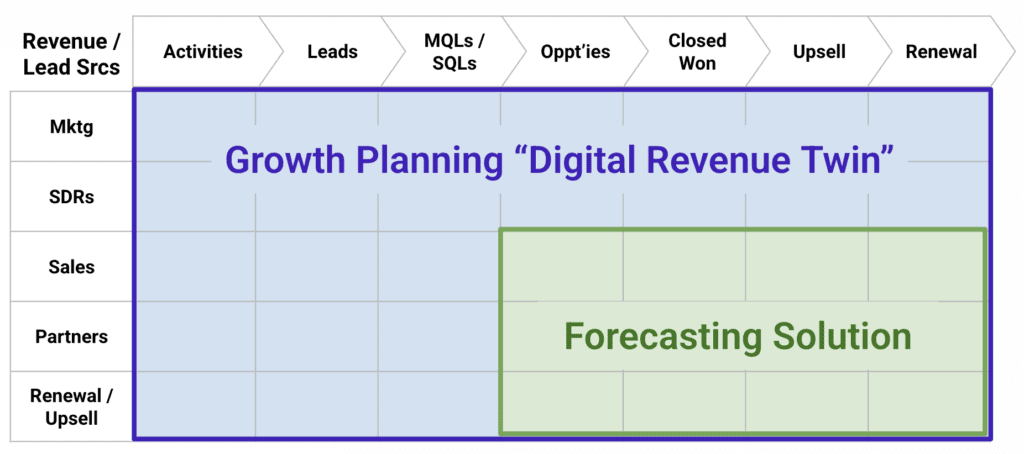
Second, forecasting tools typically start at the opportunity stage. Everything that happens before a lead becomes an opportunity, demand generation, content, events, outbound campaigns, and paid channels is outside their scope. For most B2B companies, this is where the majority of their marketing budget is spent, and forecasting offers little visibility into whether that spend is working.
Third, forecasting requires historical data to work well. A new company, a team entering a new market, or an organization that has changed its GTM motion significantly will find that forecast accuracy degrades quickly when the underlying data isn’t representative of current conditions.
Fourth, forecasting doesn’t model the relationship between activities and outcomes. It can tell you what deals are likely to close based on current signals, but it can’t tell you how many outbound sequences, marketing campaigns, or events you need to run next quarter to build a pipeline that will produce the revenue you need six months from now.
None of this is a criticism of forecasting as a category. These are simply the boundaries of what the tool was designed to do. The problems start when organizations treat forecasting as their primary planning tool, rather than as one instrument in a broader system.
What Growth Planning Is Built to Do
Growth planning, sometimes called revenue planning or GTM planning, approaches the revenue problem from the opposite direction.
Instead of starting with an existing pipeline and projecting forward, growth planning starts with a revenue goal and works backward. The central question isn’t “What will we close?” but “What do we need to do and how much of it, from which sources, to hit our target?”
A growth planning approach typically covers:
- Modeling the activities required to generate sufficient pipeline from each lead source
- Benchmarking conversion rates, deal sizes, and sales cycles against industry or lookalike data
- Planning the budget required across channels to hit pipeline targets at an acceptable CAC
- Optimizing the mix of lead sources based on efficiency, not just volume
- Tracking plan-vs-actual across the full funnel, from first marketing touch to closed revenue
The core output isn’t a forecast; it’s a plan. What do we need to do, by when, across which channels, and at what cost to hit our goal?
The Key Differences, Dimension by Dimension
Questions answered: Forecasting answers the question “What will happen?” Growth planning answers, “What do we need to do?”
Data requirements: Forecasting needs clean historical data to be accurate. Growth planning can use industry benchmarks and lookalike data to build a credible plan even without an established data set.
Funnel coverage: Forecasting covers from opportunity stage to close. Growth planning covers the entire funnel from demand generation activities through to renewal.
Benchmarking: Forecasting benchmarks typically cover closure rates and deal velocity in the sales pipeline. Growth planning benchmarks cover activity levels, conversion rates, and spend efficiency across the full GTM.
Planning resolution: Forecasting models deal-level outcomes. Growth planning models the activity volumes, by channel and lead source, needed to produce those outcomes in the first place.
Budget efficiency: Traditional forecasting usually doesn’t model the relationship between spend and revenue by source. Growth planning focuses on which channels generate pipeline, at what cost, and how that ultimately translates into revenue.
Scenario modeling: Forecasting can model scenarios around deal outcomes. Growth planning can model scenarios around channel mix. What happens if we shift budget from one lead source to another or increase activity volume in a specific area?
Which Problems Each Solves Best
Forecasting is the right tool when your primary challenge is managing the in-flight pipeline and giving leadership reliable visibility into where the quarter will land. It’s also the right tool for sales teams that need deal-level prioritization and coaching.
Growth planning is the right tool when your primary challenge is building the right pipeline in the first place from the right sources, at the right cost, in the right volumes. It’s the right tool when you’re setting annual or quarterly targets and need to know whether those targets are achievable given your resources, channels, and benchmarks.
Many mature GTM organizations use both. Forecasting manages execution in the short term. Growth planning drives the strategic decisions about where to invest, what activities to run, and whether the plan behind the forecast is actually sound.
The gap tends to hurt most at two moments: when a company is setting targets for a new year or new market and when a company is missing targets and trying to understand why. In both cases, a forecast alone doesn’t provide the answers. You need a plan and a framework for diagnosing whether the plan is the problem.
Where Premonio Fits
We’ve been objective up to this point, so it’s worth being transparent: Premonio builds a Growth Planning Digital Revenue Twin, and this is the category we operate in.
Our platform, Premonio GOALS, is designed to answer the planning questions that forecasting tools leave open. It builds a GTM plan from a revenue goal, benchmarks it against industry data, models the activities and spend required by lead source, and tracks plan-vs-actual across the full funnel. Crucially, it works without prior data, which means it’s accessible to early-stage companies and teams in new markets, not just organizations with years of CRM history.
We built it because we kept seeing the same pattern: revenue teams with solid forecasting capabilities that were still missing targets, because the problem wasn’t their forecast accuracy. It was the quality and efficiency of the pipeline feeding into it.
If that’s a challenge you’re facing, we’d be glad to show you how the model works in practice. We’ll build a live GOALS plan for your business in real time, including your revenue targets, lead source mix, and activity benchmarks. No prior data required.
FAQ
What is the core difference between forecasting and growth planning? Forecasting starts with your existing pipeline and asks, “What will we close?” Growth planning starts with a revenue goal and works backward, asking, “What do we need to do, across which channels and at what cost, to hit that target?”
What are forecasting tools best at? Forecasting tools excel at managing the in-flight pipeline. They give sales teams deal-level prioritization, help managers spot at-risk deals, track quota attainment, and provide reliable numbers for board and investor reporting.
Where do forecasting tools fall short? Forecasting only covers from the opportunity stage onward, so the entire demand generation side, content, events, outbound, paid channels are invisible to it. It also requires clean historical data, can’t explain why your pipeline is thin, and doesn’t model the relationship between activities and outcomes.
Can growth planning work without historical CRM data? Yes. Growth planning can use industry benchmarks and lookalike data to build a credible plan, making it accessible to early-stage companies or teams entering new markets, not just organizations with years of CRM history.
What does growth planning cover that forecasting doesn’t? Growth planning spans the full funnel from first marketing touch to closed revenue. It models activity volumes needed per lead source, benchmarks spend efficiency, plans budget across channels, and enables scenario modeling around channel mix, not just deal outcomes.
Do companies have to choose one or the other? No. Many mature GTM teams use both. Forecasting manages short-term execution and pipeline visibility. Growth planning drives strategic decisions about where to invest, which activities to run, and whether the plan behind the forecast is actually sound.
When does the gap between the two approaches hurt most? At two moments: when setting targets for a new year or market, and when missing targets and trying to diagnose why. In both cases, a forecast alone doesn’t provide the answers, you need an activity-level plan.
What is Premonio GOALS? Premonio GOALS is a growth planning tool. It builds a GTM plan from a revenue goal, benchmarks it against industry data, models required activities and spend by lead source, and tracks plan-vs-actual across the full funnel, without requiring prior data.


