Growth teams face a tougher-than-ever environment. Capital is costlier, boards demand measurable growth strategies and ROI, and technology – especially AI – moves faster than ever. Ambiguity, slow decisions, and misalignment are no longer tolerable. Organizations need strategies that are quick to implement and execute, precise and predictive, and fully aligned across the organization.
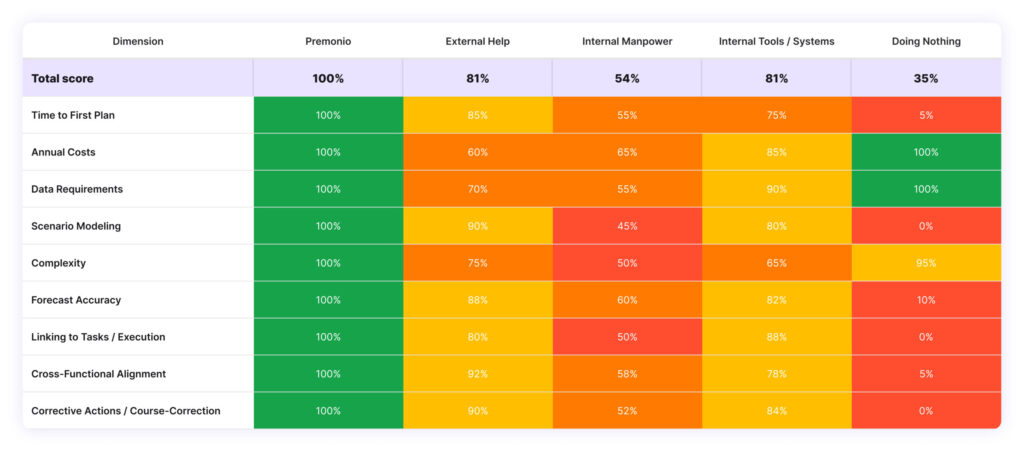
Given that, the need for new growth planning and monitoring tools and systems to replace stalwarts like disjointed, siloed spreadsheets, million Dollar rev ops implementations, or expensive consultancies is greater than ever. So, here’s an overview of today’s revenue planning landscape, organized into four principal approaches that companies can choose: Getting External Help, Relying on Internal Manpower, Company-Internal Systems and Tools, and Doing Nothing. We evaluate each of these four approaches across nine key dimensions that we typically use to evaluate effective revenue growth planning and execution approaches: Time to First Plan, Annual Costs, Data Requirements, Scenario Modeling, Complexity, Forecast Accuracy, Linking Revenue to Tasks, Cross-Functional Alignment, and Corrective Actions.
1. External Help
External help comes from platforms, frameworks, or consultants that bring expertise and structure to revenue planning.
Dynamic Sankeys, such as Funnelytics, Geru, and Vasco, offer clear visualizations of customer journeys with intuitive funnel diagrams and campaign-level insights. These platforms typically deliver a first plan within days to weeks and offer robust forecasting capabilities. They are particularly strong in marketing-focused scenarios and provide a foundation for data-driven decision-making. While they require detailed data and are primarily marketing-oriented, they give teams the ability to identify opportunities and inform planning with actionable insights. Cost is around $50K to $120K annually.
Revenue Architecture frameworks, like Winning By Design, Vasco, alongside consultants including fractional CMOs or sales consultants, offer structured sales methodologies and tailored business guidance. These approaches can produce comprehensive revenue plans over a period of weeks to months and provide high-value expertise in designing repeatable, scalable growth strategies. They help organizations establish alignment within sales and marketing teams and deliver actionable recommendations based on industry best practices.
Key takeaway: External help provides valuable structure, expertise, and clarity in revenue planning, enabling teams to make informed decisions, visualize customer journeys, and implement structured growth strategies.
2. Internal Help
Internal help relies on teams like Revenue Operations or in-house analytics groups to manage revenue planning.
Revenue Operations analytics within existing tools provide precise insights directly within familiar systems. These initiatives typically take several weeks or even months to deliver a comprehensive plan and rely on detailed data input, enabling teams to model key scenarios and improve forecasting within their toolset. They typically project growth by extrapolating future performance given past trends or date, a bottom-up approach we call “Tasks-to-Targets” since they project future outcomes by adding up the performance of different lead sources. In contrast, “Targets-to-Tasks” linkage decomposes high-level revenue targets into specific team activities or tasks. This approach helps ensure that every action is tied to measurable outcomes and supports more strategic decision-making.
Dedicated Revenue Operations departments centralize planning and analytics, creating a single source of truth for revenue strategy. Typically only focused on extrapolating past pipeline performance, they do provide manual workflows, scenario-based planning, and verification processes, ensuring consistency and alignment across teams. By leveraging internal expertise, organizations can build one-off processes that support long-term growth, continuous improvement, and clear accountability for revenue-driving actions.
Key takeaway: Internal help leverages organizational knowledge and tools to deliver structured, data-informed revenue planning, fostering alignment, repeatability, and actionable insights, while directly connecting tasks to revenue impact.
3. Internal Tools
Many organizations rely on internal systems or familiar tools to track and plan revenue, leveraging existing expertise and workflows.
Spreadsheets provide a fast, flexible way to start planning, allowing teams to map revenue assumptions and visualize scenarios quickly. They are simple to use, accessible, and a practical starting point for cross-team collaboration.
Sales forecasts produced by Sales or Sales Operations track opportunities efficiently and can be generated quickly, giving teams a clear view of pipeline health and enabling timely adjustments.
Financial models offer structured, scenario-based planning and a comprehensive view of revenue projections over time. They support strategic decision-making and can incorporate complex assumptions to guide investment and resource allocation.
Marketing plans developed by Marketing Operations provide data-driven insights into campaign performance and customer engagement, helping teams align strategy with execution.
Key takeaway: Internal systems and tools offer accessible, structured approaches to revenue planning, supporting scenario analysis, forecasting, and alignment within teams, while enabling informed decision-making across the organization.
4. Doing Nothing
Some organizations continue without structured planning, relying on product-led growth (“PLG”) or simply prior sales momentum inertia. If those are available, growth can happen but no-one knows why or by how much. When PLG or prior momentum are not available, then doing nothing leads to missed goals, overspending, and no visibility into revenue drivers. Planning is effectively infinite in duration, starts simple but quickly becomes “flying blind,” and there are no corrective actions.
Key takeaway: Inaction is likely to lead to inefficiency, misalignment, and lost revenue opportunities.
“GOALS” – The Digital Revenue Twin by Premonio
Premonio delivers a fundamentally new approach to revenue planning by combining speed, precision, and alignment across the entire organization. Its Digital Revenue Twin empowers growth teams to move beyond traditional planning methods, providing a unified platform where strategy, execution, and performance converge.
Time to First Plan: Plans are generated in minutes, with real-time plan-to-actual tracking that keeps your organization continuously informed and responsive. Unlike traditional approaches that take weeks or months, Premonio enables teams to act on insights the same day.
Annual Costs: At $5K–$35K per year, Premonio is cost-efficient and avoids the heavy data collection and consulting fees that are typical in conventional planning. This makes advanced revenue planning accessible to both growing companies and established enterprises.
Data Needs: Premonio is designed for simplicity and automation. The system self-updates and requires no historical data, enabling teams to start planning instantly without the overhead of gathering and cleaning complex datasets.
Scenario Modeling: Teams can explore unlimited growth scenarios that dynamically update as new information becomes available. This allows decision-makers to stress-test strategies, forecast multiple outcomes, and confidently choose the most effective path forward.
Complexity: GOALS is intuitive and CXO-ready. Its interface is designed for executive decision-makers while still providing enough depth for analysts to dive into operational details, striking the perfect balance between simplicity and insight.
Forecast Accuracy: Real-time verification ensures that forecasts are reliable and actionable. Instead of waiting for outdated monthly reports, teams can see how plans are performing against actual results at any moment.
Linking Revenue to Tasks and Spend: Premonio fully connects budgets, customer acquisition costs (CAC), and individual activities, creating a transparent line of sight between daily execution and strategic goals. Teams can see exactly which actions are driving revenue and where adjustments are needed.
Cross-Functional Alignment: The platform aligns every function—sales, marketing, finance, and operations—around a single source of truth. By breaking down silos, Premonio ensures that the entire organization is moving in lockstep toward revenue goals.
Corrective Actions: GOALS doesn’t just track performance; it guides it. The system automatically identifies discrepancies, highlights opportunities, and recommends next steps, making continuous improvement effortless.
Key takeaway: Premonio transforms revenue planning from a slow, fragmented process into a dynamic, organization-wide capability. By delivering speed, clarity, alignment, and actionable insights, it empowers growth teams to make confident, data-driven decisions—turning revenue strategy into a living, responsive system rather than a static plan.

Summary
In today’s capital-constrained, AI-accelerated landscape, growth teams face unprecedented pressure to deliver predictable, defensible revenue outcomes. Traditional planning motions—external consultants, internal ops teams, and familiar tools like spreadsheets—struggle to keep pace. They are slow, data-heavy, siloed, and lack real-time verification or actionable alignment across functions.
External support (platforms, dynamic funnels, consultants) offers structure but is costly, takes weeks to months to produce usable plans, and rarely drives cross-functional execution.
Internal resources (RevOps or analytics teams) bring institutional knowledge but remain constrained by long development cycles, manual modeling, and limited scenario flexibility.
Internal tools (spreadsheets, forecasts, financial models, marketing plans) are familiar but fragmented, non-dynamic, and incapable of linking revenue targets to operational KPIs.
Doing nothing leaves organizations with no visibility, no alignment, and no path to predictable growth.
GOALS, Premonio’s Digital Revenue Twin, eliminates these constraints by automating the entire revenue-growth cycle.
It delivers a revenue plan in minutes, requires no prior data, updates automatically, models unlimited scenarios, verifies forecasts in real time, aligns all GTM functions, and recommends corrective actions when results drift. With annual costs of roughly 10% to 20% of traditional approaches, it transforms revenue planning into a dynamic, always-on capability.
The outcome: faster decisions, stronger alignment, and predictable revenue growth at scale.
FAQ
1. What makes Premonio different from traditional planning tools?
Premonio connects revenue targets directly to the activities, budgets, and capacity needed to achieve them—automatically. Instead of manual modeling or siloed tools, the platform self-updates, verifies forecasts in real time, and aligns every GTM function around a single source of truth.
2. Do I need historical data to get started?
No. GOALS generates a first plan in minutes without any prior data and improves itself as new information flows into the system.
3. How long does it take to produce a full growth plan?
Traditional methods take weeks to months. Premonio produces a full revenue model—complete with pipeline requirements, budgets, and capacity planning—in just minutes.
4. Is this only for marketing or sales teams?
No. The Digital Revenue Twin aligns the entire organization, including Sales, Marketing, RevOps, Finance, and Leadership. It’s designed as a company-wide decision system, not a department tool.
5. How does Premonio help with alignment?
The platform ties revenue goals to functional responsibilities and activity-level KPIs. Everyone sees the same targets, the same assumptions, and the same real-time performance diagnostics.
6. Can we model multiple scenarios (best case, worst case, etc.)?
Yes. GOALS supports unlimited, dynamically updated scenarios—making it simple to test trade-offs, budget shifts, or growth strategies without rebuilding models manually.
7. Does it provide corrective actions?
Yes. When the plan and actuals diverge, the system automatically identifies the root cause and recommends next steps.
8. How expensive is Premonio compared to alternatives?
External consultants or dynamic funnel platforms often run $50K–$500K annually, with long delivery cycles. Premonio costs $5K–$35K annually and delivers usable output immediately.
9. Who is the platform designed for?
CEOs, CROs, CMOs, RevOps, and investors—anyone who needs clarity, speed, and alignment across the revenue engine.
10. What results can organizations expect?
More predictable revenue, faster GTM decisions, cross-functional alignment, and immediate visibility into what’s working—and what’s not.